
A hair dryer vs hair straightener choice comes down to one question: do you need to dry your hair, or do you need to shape it? A dryer removes moisture with airflow. A straightener uses heated plates to shape dry hair. They do different jobs, and most people need both, just not every day.
A hair dryer removes moisture with airflow, while a conventional hair straightener uses heated plates to shape dry hair. Choose by the job you need to do and the tool’s directions, rather than assuming the hottest or most expensive device is the right one.
The useful comparison begins before you open a product listing. Think about how you normally wear your hair, how much time you spend styling and whether you need to dry it, smooth it or create a particular shape. Those are related tasks, but they are not identical.
Compare the purpose of each tool
| Tool | Primary purpose | Features to compare |
|---|---|---|
| Hair dryer | Drying with airflow | Heat and airflow controls, weight, diffuser or concentrator |
| Conventional flat iron | Shaping and smoothing dry hair | Adjustable heat, plate width, grip and clear directions |
| Air multi-styler | Different jobs with attachments | Attachment purpose, intended starting moisture level and handling |
| Curling iron | Creating a curl or wave | Barrel size, adjustable heat and handling instructions |
Device designs vary. Some tools are made for a specific damp-to-dry process, while conventional heated plates are generally used on dry hair. Never transfer the directions for one device to another simply because they look similar.
If you mainly need to dry your hair
Start your shortlist with hair dryers. Compare separate heat and airflow controls so you can understand what is adjustable. Look at the attachments included with the exact model and whether replacements are available from the maker.
A concentrator directs airflow toward a smaller area, while a diffuser distributes it differently for styling. The right attachment depends on your hair and intended result. Check the maker’s guide for how an attachment is meant to be positioned and used.
Think about handling as well. A long drying session can make the weight, balance and location of the controls more noticeable than a promotional feature list suggests. If a store offers a display model, assessing the grip can help you judge comfort without relying on a photograph.
If you want a smoother finish
A conventional flat iron may be relevant after the hair is dry. The American Academy of Dermatology recommends low or medium settings for flat irons and cautions that excessive heat can damage any hair type. Higher maximum temperature is therefore not a stand-alone reason to choose a device.
Compare how clearly the temperature controls work, whether the instructions describe your intended use, and how the plate width would fit the sections you normally style. Look for practical information rather than treating ceramic, titanium or another material name as a complete performance verdict.
For a full guide to flat irons, see our 7 best hair straighteners for women in 2026.
Plan for less heat exposure
Dermatology guidance favors reducing unnecessary heat and using low or medium settings with a heat-protective product. Letting hair partially air-dry can reduce the drying work a tool needs to do. A heat protectant does not make excessive heat harmless.
Be gentle before styling too. The AAD recommends conditioner after shampooing and handling wet hair according to its texture. Detangling tightly curled hair and straight hair can call for different approaches. Avoid treating every hair-care video as a universal set of instructions.
Hair dryer vs hair straightener: the 3 products that answer this question
These three products cover the hair dryer vs hair straightener question: a flat iron for straightening, a diffuser straightener that does both jobs, and a heat protectant to use before either one. They are the ones we stock through Amazon.
1. BaBylissPRO Nano Titanium Flat Straightener, best flat iron
The BaBylissPRO Nano Titanium Flat Straightener is a flat iron for shaping and smoothing dry hair. It uses nano titanium plates and adjustable heat, so you can set a low or medium temperature and straighten in smooth passes. Use it only on dry hair, after your hair is fully dried.
Best for: straightening dry hair, a smooth finish, adjustable heat.
Watch out for: it is a flat iron, not a dryer, so it will not dry wet hair. Always dry your hair first, and use a heat protectant before you straighten. Do not use the highest setting unless your hair type needs it.
2. StyleVibe Diffuser Straightener, best for both jobs
The StyleVibe Diffuser Straightener is a diffuser straightener that can do both jobs: it dries and straightens in one tool, with a diffuser for frizz-free blowouts. If you want one tool that dries your hair and smooths it, this is the one to look at. It is the closest thing to a dryer and a straightener in a single device.
Best for: one tool for drying and straightening, frizz-free blowouts, a diffuser finish.
Watch out for: a multi-purpose tool is a compromise, so it may not dry as fast as a dedicated dryer or straighten as precisely as a dedicated flat iron. If you straighten every day, a dedicated flat iron may suit you better. For more flat iron picks, see our 7 best hair straighteners for women in 2026.
3. ROZ Lightweight Conditioner and Heat Protectant, best heat protectant
The ROZ Lightweight Conditioner and Heat Protectant is a lightweight conditioner that also protects your hair from heat. Use it before you dry or straighten, so your hair has a protective layer between it and the heat. It is lightweight, so it will not weigh your hair down or make it greasy.
Best for: heat protection before drying or straightening, a lightweight conditioner, daily use.
Watch out for: a heat protectant reduces damage, it does not make excessive heat harmless. Still use low or medium settings, and do not straighten the same section over and over. Check the listing for the size and directions.
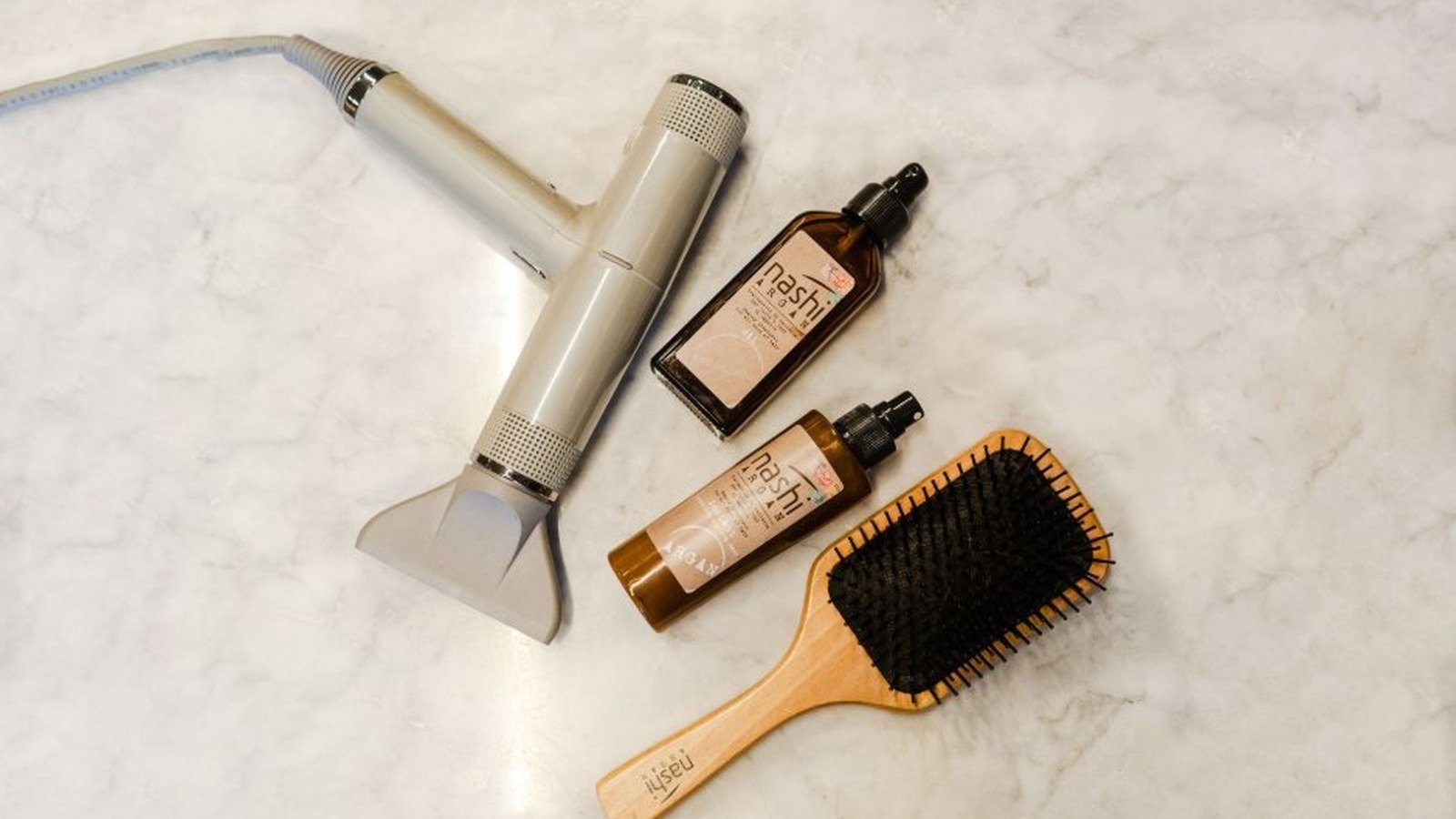
Does a multi-styler make more sense?
It can be convenient when you will actually use several attachments. Make a list of the styles you repeat most often, then match each one to a supplied attachment. If several attachments would stay in the box, a simpler tool may fit your routine better.
Check the exact model number. Similar product names can refer to different devices, and an attachment that fits one model may not fit another. Confirm the attachments included with the exact model you are buying, and check whether replacements are available.
Blow-dry or straighten? The Christmas hair answer
For a Christmas party, the answer depends on the look you want. If you want volume and movement, blow-dry with a round brush and a concentrator, then finish with a light hold. If you want a sleek, straight look, blow-dry first until your hair is fully dry, then straighten in smooth passes with a flat iron on a low or medium setting, using a heat protectant first. Do not straighten damp hair, and do not skip the heat protectant just because you are in a hurry. The extra five minutes are what keep your hair looking good the next day too.
If your hair is thinning or damaged, see our guide: hair care for thinning and damaged hair, what actually helps.
Frequently asked questions
Is a hair dryer or straightener less damaging?
A hair dryer is generally less damaging than a straightener, because it uses airflow rather than direct contact with heated plates. But both can damage hair if used on high heat without protection. The safest approach is to use low or medium settings, a heat protectant, and to let your hair partially air-dry before you use either tool. A straightener on damp hair is the most damaging combination, so always dry first.
Can a straightener replace a dryer?
No, not really. A straightener is designed for dry hair, and it will not dry wet hair safely or effectively. Running a flat iron over damp hair can cause steam damage and breakage. You need a dryer (or air-drying) to remove the moisture first, then a straightener to shape it. A diffuser straightener like the StyleVibe above is the exception, because it is designed to dry and straighten in one tool.
Do I need both a dryer and a straightener?
It depends on how you wear your hair. If you wear it straight most days, you need both: a dryer to remove moisture, and a straightener to smooth it. If you wear it natural or wavy, a dryer with a diffuser may be enough. If you only straighten for special occasions, a diffuser straightener that does both jobs may be the better buy.